Getting Out of a Lease in Switzerland: Your 3 Options Compared
Want out of your lease? Maybe your life situation has changed, you're moving abroad, or the car just doesn't fit anymore. The good news: you have options. The less good news: not every route costs the same.
To help you really understand the differences, we'll work through a concrete example in this article. The numbers come from an actual Swiss lease agreement:
Vehicle price: CHF 78,000
Term: 48 months
Calculated residual value at end of contract: CHF 45,493
Monthly lease payment: around CHF 850
Let's look at what happens if you want to get out after 24 months, halfway through the contract.
Option 1: Early Contract Termination
The most direct route is early termination. Under the Swiss Consumer Credit Act (KKG, Art. 17 para. 3), you as a private leaseholder can terminate your contract with at least 30 days' notice every three-month period. This is your legal right, as long as the contract falls under the KKG (private use, credit amount up to CHF 80,000).
What many people underestimate: the leasing company will retroactively recalculate your payments. The reason is simple. A car loses a disproportionate amount of value in its first years. In a lease agreement, however, this depreciation is spread evenly across the entire term. If you exit after two of four years, your payments so far have covered less depreciation than has actually occurred. You have to make up that difference.
What this means in numbers: For our example vehicle, after 24 months you're looking at a catch-up payment of around CHF 11,625. That's the amount from the termination table, on top of the payments you've already made. Add potential administration fees, reconditioning costs and excess mileage charges, and you can easily end up at CHF 12,000 to 13,000.
You can see exactly how high the catch-up payment will be in the residual value table (also known as the "Kremoblatt"), which is part of your lease contract. The earlier you terminate, the higher the payment. For comparison: after just 12 months, it would be around CHF 15,121 in our example.
Important to know: The Swiss Federal Supreme Court has ruled (BGE 4A.404/2008) that a residual value table is invalid if early termination ends up costing more than simply continuing the contract. If the final bill looks suspiciously high, it's worth having it reviewed by a specialist.
Bottom line: early contract termination is the fastest but usually the most expensive way out of a lease. In our example, exiting after 24 months costs around CHF 12,000 to 13,000, and you end up without a car.
Option 2: Buying Out the Vehicle
You can try to buy the vehicle out of the lease contract. But there's a widespread misconception here: a lease is not a hire purchase. The payments you've made so far cover usage and interest costs. They are not deducted from a purchase price.
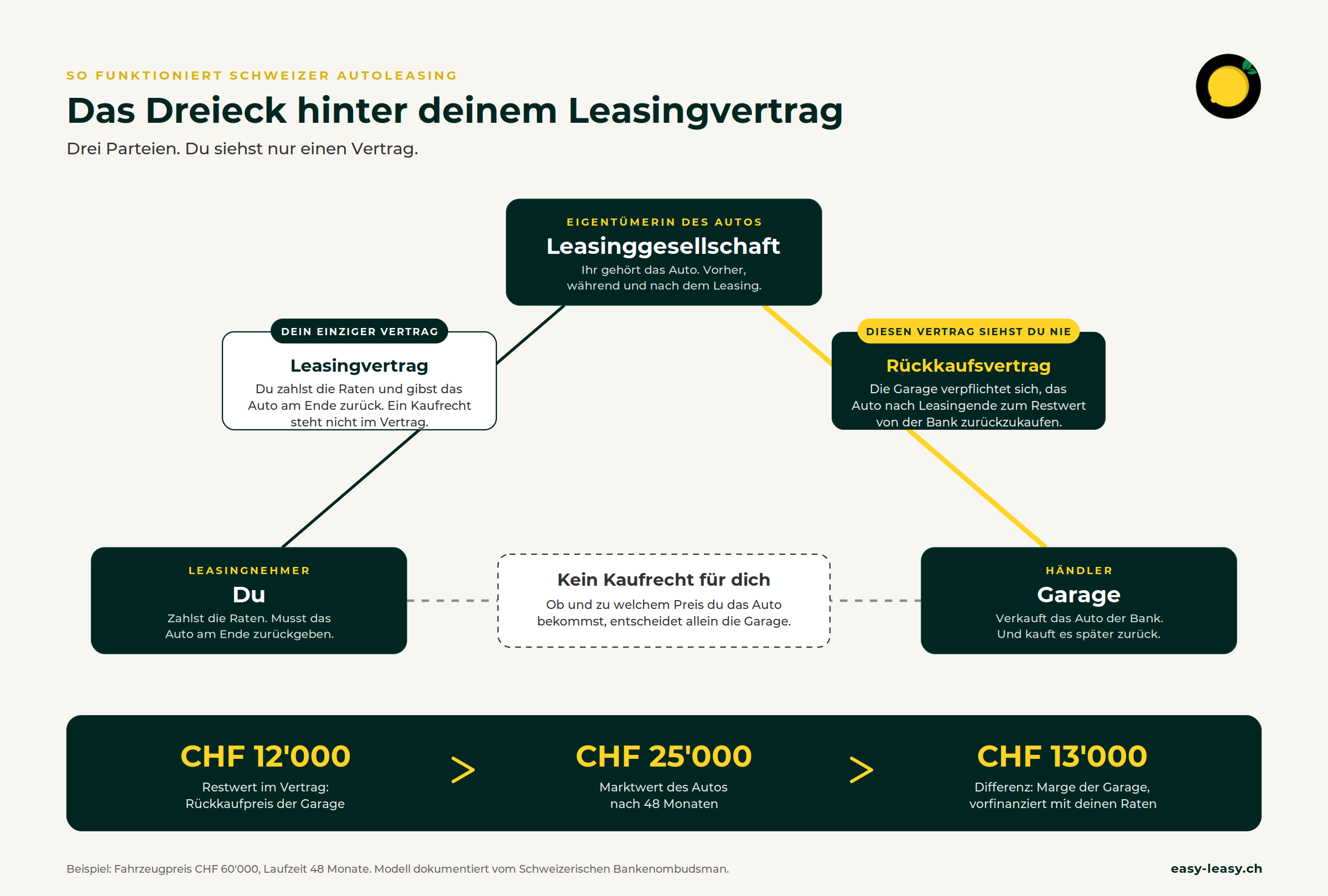
In principle, the vehicle belongs to the leasing company for the entire duration of the contract. You are a user, not an owner. The residual value stated in the contract is a calculated figure, not an automatic sale price. There is no legal right to purchase, unless you agreed on a pre-emption right when signing the contract.
In practice, things are often less complicated than they look on paper. If you contact the bank or the dealership and ask for the current book value, you'll often receive a buyout offer. The bank has no outstanding claim afterwards, and the dealership avoids the residual value risk and the effort of remarketing. For both sides, it's a clean solution.
Caution is advised with particularly value-stable or sought-after vehicles. If the market value is significantly above the book value, the dealership may insist on its buyback right to resell the vehicle at a profit. In that case, a buyout becomes harder or more expensive.
What this means in numbers: After 24 months, the calculated residual value of our example vehicle is around CHF 51,940. Let's assume the current market value of the two-year-old vehicle is approximately CHF 50,000. The dealership offers you a buyout at book value. So you pay around CHF 52,000 and you have the car. Now the question is: what do you do with it?
Route A: Keep it yourself or sell it privately
If you want to keep the car, the calculation is straightforward. You pay the book value, the car is yours. This can be worthwhile, especially if you received a good fleet discount when signing the lease and the book value is therefore below the actual market value.
If you want to resell the car, things get more involved. As a private seller, you typically sell for less than a dealer would. You can't offer a warranty, no professional reconditioning, and you reach fewer buyers. A listing on AutoScout24 costs CHF 350 or more. On Facebook Marketplace and Tutti there are no listing fees, but you deal with more non-committal enquiries. On top of that comes the time for viewings, price negotiations and the entire sales process.
In our example: you buy the car out for around CHF 52,000 and list it privately for CHF 50,000. After negotiations, you might sell it for CHF 47,000 to 48,000. Plus CHF 350 for the listing. The bottom line: you lose around CHF 4,000 to 5,000, and you had all the hassle on top.
Route B: Sell or trade in through a dealer
Alternatively, you can trade in the vehicle at a dealer or put it on consignment after the buyout. It sounds more convenient, but it costs a fair chunk in margin.
For a trade-in, dealers typically calculate 10 to 15% below market value. That's their margin for reconditioning, storage risk and remarketing. For consignment, where the dealer sells the car on your behalf, the commission is often around 10%.
In our example: you buy the car out for CHF 52,000. On a trade-in, the dealer offers you CHF 42,500 to 45,000 (market value CHF 50,000 minus 10 to 15%). You lose CHF 7,000 to 9,500. On consignment at CHF 50,000, after 10% commission you keep CHF 45,000, a loss of around CHF 7,000.
In both cases, there's an additional party between you and the proceeds that wants its cut.
Bottom line: a buyout makes sense if you want to keep the car. For reselling, you either lose time and effort (private sale) or margin (dealer). You rarely come out of this cheaply.
Option 3: Lease Takeover
With a lease takeover, your existing contract is transferred to another person. That person takes on all rights and obligations under the existing terms: same payment, same remaining term, same mileage allowance.
For you as the current leaseholder, this is the most financially attractive route. There's no retroactive payment increase, no residual value table catch-up and no termination fees. You're free of the contract without losing money.
For a takeover to go through, the leasing bank must approve it. The new lessee must meet the usual requirements: residence in Switzerland, valid ID or residence permit, a driving licence and a positive credit check. If these conditions are met, there's usually nothing standing in the way of a transfer.
The model is also attractive for the person taking over. A shorter remaining term than with a new lease, often an appealing monthly payment, and a well-maintained vehicle with a known history. Instead of a three or four-year commitment, it might only be 12 or 18 months.
What this means in numbers: You exit after 24 months. Your costs? Practically zero. The only charges are a processing fee from the leasing company which usually is between CHF 200 and 500. For comparison: with Option 1, it would have been over CHF 12,000. With Option 2, you'd have lost CHF 4,000 to 9,500 depending on the route.
The only downside: if you made a down payment when signing the lease, that money is generally gone. The new lessee will hardly be willing to reimburse part of it. Keep that in mind when doing your calculations.
Which Route Is Right for You?
Early contract termination is fast but expensive. In our example, over CHF 12,000, and you end up without a car. This really only makes sense if you need out very quickly and there's no alternative.
A buyout works if you genuinely want to keep the car. If you want to resell it, you either lose time and effort on a private sale, or CHF 7,000 to 9,500 in dealer margin.
A lease takeover is the smartest option in most cases. In our example, you save over CHF 11,000 compared to early termination. No depreciation catch-up, no remarketing risk, no effort selling. You hand the contract to someone who is looking for exactly this kind of deal.
How a Lease Takeover Works with Easy Leasy
At Easy Leasy, you can list your vehicle for free. We handle the enquiry management, pre-qualify interested parties, coordinate viewing appointments and are personally on site. If you'd like, we also organise a professional photo shoot, a vehicle inspection and a CarVertical report. You focus on what matters, we take care of the rest.