Buying Your Leased Car: Why It Won't Be Yours in the End
The salesperson means well: «Go for a low residual value. You'll pay more each month, but at the end you can take the car over cheaply.» Sounds logical. Four years later you want to buy the car and you hear: not possible. Or: possible, but it'll cost you CHF 13'000 more than you thought.
This isn't a misunderstanding and it isn't a dishonest dealer. It's how car leasing normally works in Switzerland. Nowhere in a standard leasing contract does it say you're allowed to buy the car at the end.
Does this even affect you?
Two questions and you'll know.
Do you plan to hand your leased car back at the end and take a new one? Then everything is fine. Nothing changes for you.
Do you want to keep the car? Or has someone advised you to pick a low residual value so you can take it over cheaply later on? Then keep reading. There are several thousand francs at stake.
Who owns the car?
Most people picture leasing like this: you pay the car off in instalments, and at the end it's yours. That's how a hire purchase works. Leasing is something else.
With a lease, the bank buys the car and lets you drive it. You're paying for the right to drive it. Not for it to become yours one day. The car belongs to the leasing company the entire time, even after your final instalment. Your contract obliges you to do two things: pay, and hand the car back at the end.
This isn't a matter of interpretation, it's spelled out in the terms you signed. Cembra puts it like this in section 1.3: «The leaseholder has no right to acquire the leased object.» Plus the obligation to return the car when the contract ends. AMAG Leasing uses the same sentence in the same section, just with «vehicle» instead of «leased object». Two of the largest leasing companies in the country, the same clause. This isn't an isolated case, it's the standard.
Worth knowing: The residual value is not a purchase price. It's just a figure the bank uses to calculate your monthly instalment. The lower the residual value, the higher the instalment. Both leasing companies state right after the clause that this figure appears in the contract purely for your information. It gives you no right to buy the car at that price.
Why you can't simply call the bank at the end
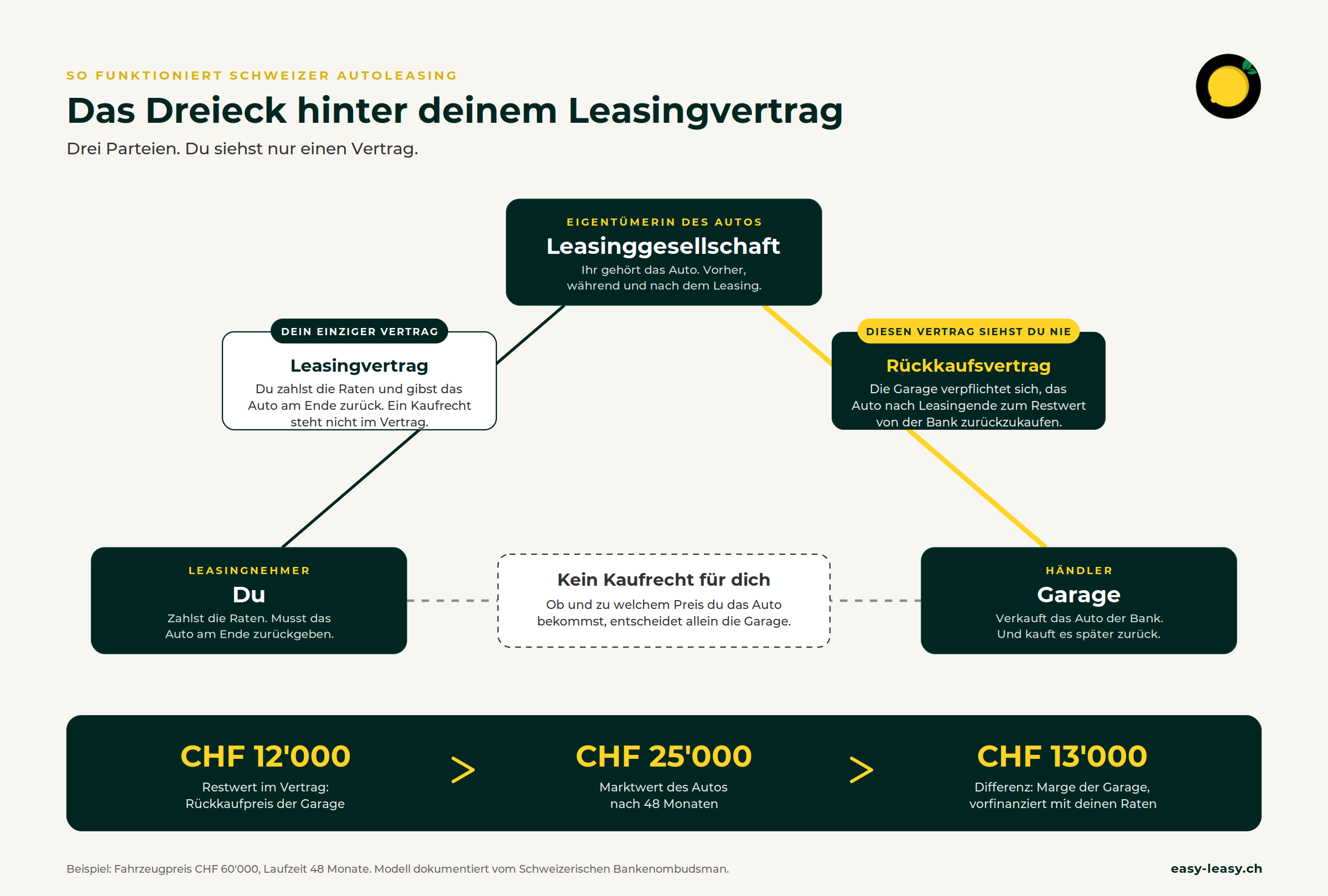
There are three parties involved in your lease: you, the bank, and the dealer where you picked out the car. You only know your own contract with the bank. But there's a second contract you'll never hear about.
The bank doesn't want a used car sitting in its yard, it's a bank. So it makes an arrangement with the dealer: when your lease ends, the dealer takes the car back and pays the bank the residual value. The two of them sign this contract without you.
That gives the dealer the right of first refusal, first claim on the car. After the lease, the car goes back to the dealer, not to you. Whether the dealer then sells it on to you, and at what price, is entirely their call. At the residual value or at the higher market price: purely a matter of negotiation.
The Swiss Banking Ombudsman, the official mediation body for disputes between customers and banks, handled exactly this case. On the salesperson's advice, a customer had agreed to a low residual value and high instalments so he could buy the car cheaply at the end. Shortly before the contract ran out, the bank told him: you have no purchase right, you have to return the car. And the bank was obliged to sell it to the dealer. The Ombudsman couldn't do anything for him. His conclusion: the bank had acted correctly, and the dealer had made the deal. SRF Kassensturz covered a similar case: four years of high instalments paid, then the dealer wanted more than the residual value, otherwise he'd take the car back.
Whatever the salesperson promised you verbally counts for nothing in this situation. He doesn't speak for the bank. And the leasing terms settle that unambiguously too, at AMAG in section 19.3: «Verbal side agreements are invalid.»
What a low residual value costs you
Let's run the numbers. You lease a car for CHF 60'000 over 48 months.
With a normal residual value of CHF 30'000, you pay around CHF 800 a month. The salesperson suggests a residual value of CHF 12'000 instead. That pushes your instalment up to around CHF 1'150.
What that means in numbers: CHF 350 more per month, roughly CHF 17'000 over four years. That money isn't lost, it sits in the low residual value. But only if you actually get the car at that residual value in the end.
If you don't, the maths looks like this: after four years the car is still worth CHF 25'000. The dealer buys it from the bank for CHF 12'000 and sells it on at the market price. The difference of CHF 13'000 is his profit, and you built it up with your high instalments. You end up without a car, having paid CHF 17'000 more than someone who drove the same car on a normal residual value.
Is a purchase right even allowed?
Some providers claim a purchase right isn't legally possible with a lease. That's not true. There's no law prohibiting a purchase right.
Here's what is true: if the bank gave you a fixed purchase right in the leasing contract, it would no longer be a lease but a hire purchase. Stricter rules apply to those and they involve more paperwork, including an entry in an official register. The leasing companies would rather avoid that effort. You not getting a purchase right is an industry decision, not a law.
There's a second argument you hear a lot: a purchase right is dangerous because it forces you to buy. That's nonsense. A right isn't an obligation. You can buy if you want to, and leave it if you don't.
How to protect yourself before you sign
The bank won't give you a purchase right. The dealer is free to. He can commit in writing to selling you the car at a set price after the lease. That's allowed and it has nothing to do with your leasing contract.
For that commitment to be worth anything, it needs to contain three things:
A fixed price in francs. Not «at the residual value», but an actual number.
A deadline by which you have to make up your mind.
An obligation on the dealer to buy the car back from the bank and sell it to you. Not merely: «We'll offer it to you if we get it.»
Careful, common trap: Some dealers will put a document in front of you in which you commit to taking the car over at the end. That's the opposite of what you want. The obligation has to sit with the dealer, the choice with you.
Also be aware: even with that commitment, you have no right to the car itself, just a promise from the dealer. If he doesn't get the car, or if his business no longer exists in four years, you still end up without one. You can claim money then, but not the car.
The simplest test for your dealer
Ask for the written commitment before you sign the leasing contract. Then watch what happens.
A dealer who means it honestly won't have a problem with it. He loses nothing by putting in writing what he already promised you verbally. If he waves it off, talks it down or claims it isn't legally possible: warning sign. Someone who won't sign his own promise may already be counting on the profit at the end. Especially if he's the one who advised the low residual value, his reaction tells you what he's really planning.
If you get nothing in writing, go with a normal residual value. Then you pay less every month and you're risking nothing.
If you're already stuck in a contract like this
Maybe you're recognising your own contract right now: high instalment, low residual value, nothing in writing. The good news: you can still ask for that written commitment.
The agreement with the dealer is a separate contract between you and him. Your bank isn't part of it, and there's no deadline by which something like that has to be in place. So you can walk in halfway through the term and ask. A dealer who honestly recommended that low residual value back then loses nothing by it. He's only confirming in writing what he intended to do anyway.
One difference to signing day remains: back then the dealer wanted the sale and had a reason to accommodate you. Now he already has it. So a no doesn't necessarily mean he was out to trick you. A yes, on the other hand, is worth all the more, because he gets nothing for it anymore.
Ask in good time. In the final month of your contract, the dealer may well have earmarked the car already. Six months to a year ahead is realistic, that's when he's putting his used car stock together. And the answer helps you either way: a yes gives you certainty for the rest of the term. A no tells you early enough that you're paying for pure usage, and leaves you time to adjust.
Not sure what's still possible in your situation? Write to us at Easy Leasy. We see leasing contracts every day and we know the terms of the major leasing companies. We'll tell you what's realistically achievable, including when the honest answer is: nothing anymore.
And next time you'll know: the written commitment first, then the signature.