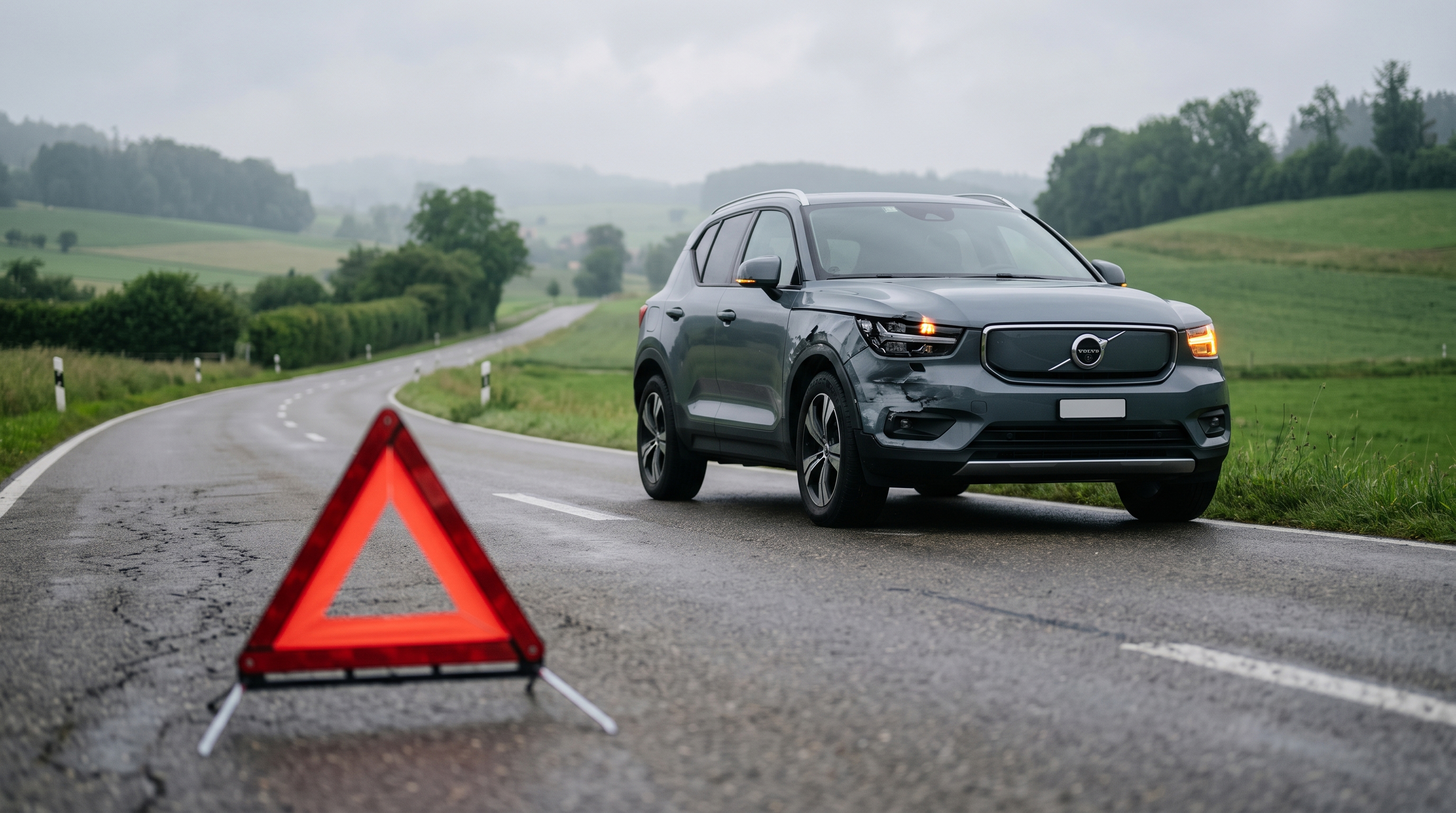
An accident with your leased car takes a second. The paperwork afterwards feels like a month. And unlike with a car you own, someone else has a say besides your insurer: the leasing company. Because the car sitting at the roadside with its bodywork bent out of shape doesn't belong to you, it belongs to the bank. After a fender bender, you'll barely notice. After a total loss, that one fact decides where the insurance money goes and whether you end up paying out of your own pocket. Here's the whole story, step by step.
Who you need to inform after the accident
Right after the accident, the usual rules apply: secure the scene, call the police if anyone is injured, take photos, fill in the European Accident Statement and don't sign anything that could count as an admission of fault.
Then comes the leasing difference: you report the damage not only to your insurer but also to the leasing company. As the owner, it wants a say in where and how the car gets repaired. Don't commission any repairs without checking with the leasing company first, and most contracts require an official brand garage.
The one exception is minor damage: below a certain repair amount, you don't need to report it separately to the leasing company. Where that threshold sits varies a lot, from CHF 1'000 to CHF 5'000 depending on the company. Check your contract terms, and when in doubt: better to report once too often.
A fender bender: annoying, but the rules are clear
With repairable damage, the situation is manageable. If the other party is at fault, their liability insurance pays. If it was your fault, your fully comprehensive insurance covers the repair, you pay the deductible and, depending on your policy, you move up to a more expensive premium level.
Two things still need saying: your lease payments keep running, even while the car spends two weeks in the workshop. And the deductible stays with you either way. After that, the contract simply continues as if nothing had happened.
It only gets really expensive when there's nothing left to repair.
Total loss: why the insurance money goes to the bank
A total loss means the repair would cost more than the car is still worth, or that there's technically nothing left to save. A stolen car that doesn't turn up within about 30 days also counts as a total loss.
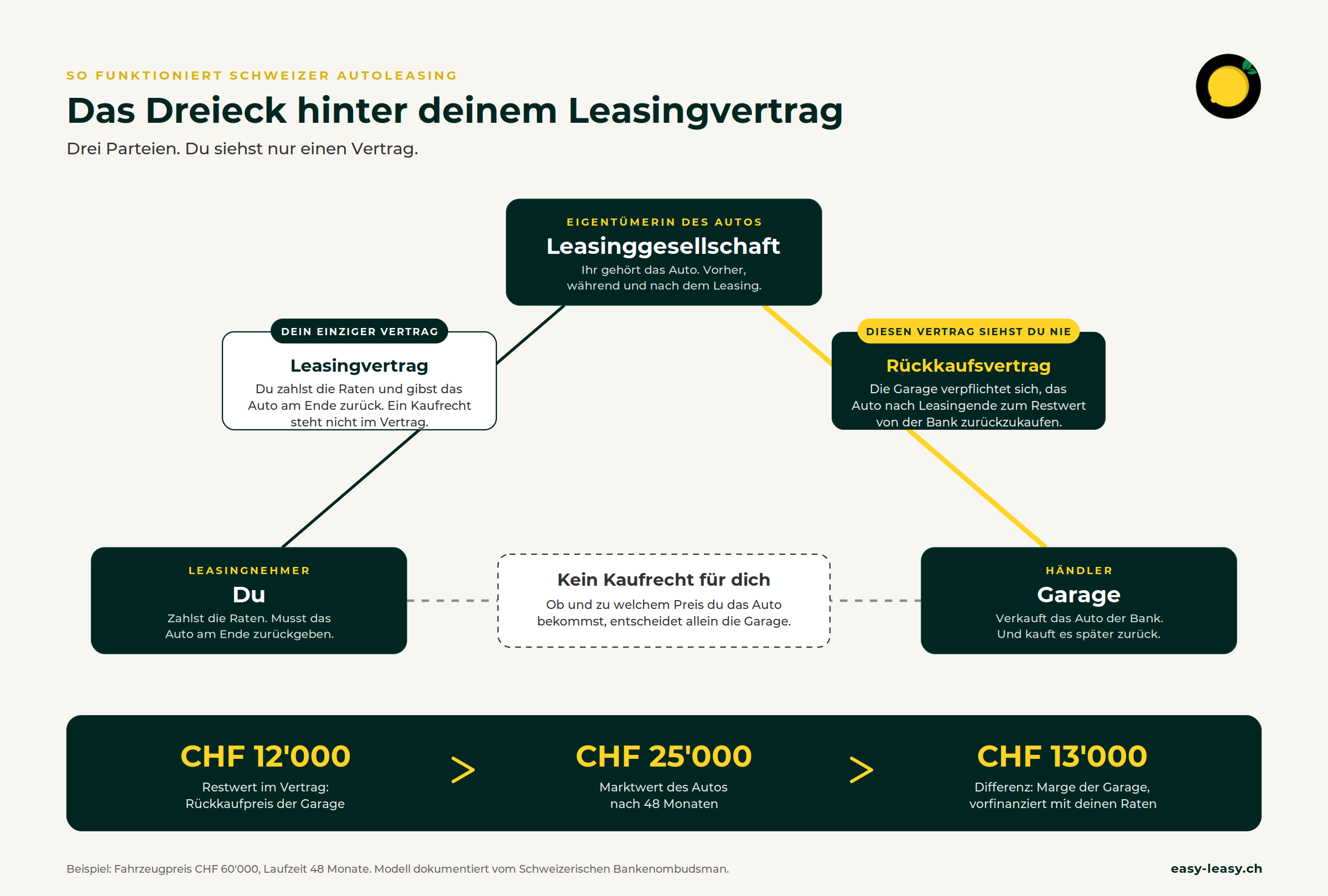
Now a detail becomes important that you signed when you took out the contract, probably without giving it much thought: the assignment of claims, known in Swiss contracts as the Zession. With this declaration, you assigned all claims from your fully comprehensive insurance to the leasing company. At some companies it's even a separate form that your insurer has to confirm with a stamp. The consequence: the payout doesn't land in your account, it goes straight to the bank. That's not a trick, it's the logical result of the ownership question. The bank paid for the car, so it secures the car's value.
In a total loss, the leasing contract is terminated early. One point deserves attention here: depending on the company, your lease payments keep running until the insurance money has actually arrived at the bank, and in theft cases that's almost always how it works. This can drag on for months.
What the settlement looks like: a worked example
After the termination, the leasing company draws up a final settlement. Put simply, it adds up its outstanding claim, meaning the remaining debt from your contract including the calculated residual value, and deducts the insurance payment from it. If a difference remains, you owe it, usually payable within ten days.
Let's make it concrete. Your car had a list price of CHF 60'000, and the accident happens in its third year on the road. The bank's outstanding claim is CHF 38'000. But the car's current value is only CHF 33'000, because cars lose value faster in the early years than a leasing contract amortises. If your insurance pays only the current value, CHF 5'000 is missing. Add your deductible, say CHF 1'000. That makes CHF 6'000 out of your own pocket, for a car you no longer have.
Good to know: It also works the other way round. If the insurance pays out more than the bank is owed, the surplus belongs to you. AMAG Leasing states this explicitly in its leasing terms, and Cembra actively asks for your bank details in a claim so it can transfer the surplus back. You still shouldn't count on one, because whether a surplus arises at all depends on your insurance cover.
Zeitwertzusatz and GAP: how to close the gap
This gap is exactly what the Swiss Zeitwertzusatz, the current value supplement, is there for. Most leasing contracts require fully comprehensive insurance anyway, often explicitly with Zeitwertzusatz. The payout then follows a scale: in the first two years of operation, many insurers pay 100 percent of the purchase price, and from the third year onwards, depending on the insurer, current value plus 20 percent or 70 to 90 percent of the purchase price.
In the example above, that's what saves you: current value plus 20 percent comes to CHF 39'600, the bank's claim of CHF 38'000 is covered, and all you pay is the deductible. Without the supplement, you'd have been stuck with CHF 5'000.
If you want full protection for longer, some insurers offer replacement value or purchase price protection variants that pay 100 percent into the fifth or even the seventh year. And then there's GAP insurance, which doesn't look at the current value at all but specifically covers the difference to the remaining debt on your leasing contract. Which solution fits depends on the age of the car and your contract. The only thing that matters is that you settle the question before the crash. Afterwards it's too late.
What this means for a lease takeover
If you're taking over a running leasing contract, this topic matters twice over. First, you need your own fully comprehensive insurance with an assignment of claims before the transfer, and the leasing company will ask for proof before it puts the contract in your name. Second, you're taking over a car that's usually in its second or third year, which is exactly when the classic Zeitwertzusatz starts to taper off. So choose your cover deliberately and clarify with the insurer what its scale is based on, because as the new lessee you don't have a purchase receipt of your own.
And take a look at the vehicle's accident history before you take over. A properly repaired previous claim isn't a deal-breaker, but you want to know about it before you sign, not after.
If you're currently thinking about taking over a leasing contract or handing over your own: on easy-leasy.ch you'll find current lease takeovers from all over Switzerland, and we'll guide you through the process, insurance question included.
An accident with your leased car isn't the end of the world. But it is the moment that shows whether your insurance actually matches your contract. The good news: you can check that today in ten minutes, no dented bodywork required.